Glyphs of the Great Lab: A Quiz on Chemistry’s Secret Symbols

Laboratory glassware may clink and burners may roar, but the real magic of chemistry hides in its symbols and representations. This quiz turns beakers and equations into a code-breaking adventure, where every letter, arrow, and squiggle means something precise. From cryptic orbital diagrams to the shorthand of reaction mechanisms, chemistry uses a visual language that tells complete stories about atoms, energy, and change. Curious how a tiny arrow can reveal who “wins” an acid–base battle, or why brackets and charges turn a neutral molecule into an ionic celebrity? These questions explore the signs that chemists use to track electrons, balance reactions, and predict what happens next in a test tube. Sharpen your scientific instincts, trust your pattern-spotting skills, and see how fluent you are in the secret script of the molecular world. Reference ID: 7014
1
What does the symbol (aq) indicate when written after a chemical formula such as NaCl(aq)?

2
In acid–base chemistry, what does the symbol pH numerically represent?

3
Which of the following best describes what the symbol Δ placed above the arrow in a reaction equation signifies?

4
What does the notation [ ] around a chemical species, such as [Cl⁻], commonly represent in solution chemistry?

5
In a balanced chemical equation, what does the arrow symbol (→) most specifically represent?

6
What does the double arrow symbol (⇌) in a chemical equation indicate about the reaction?

7
In electron configuration notation, what does the superscript in 3p⁴ specifically represent?
8
In organic reaction mechanisms, what does a curved arrow with a full head (not a half-head) specifically show?
9
In Lewis structures, what does a single line drawn between two atomic symbols represent?

10
Which chemical symbol represents the element whose atoms each contain exactly 26 protons?
0
out of 10
Quiz Complete!
Decoding Chemistry’s Secret Symbols
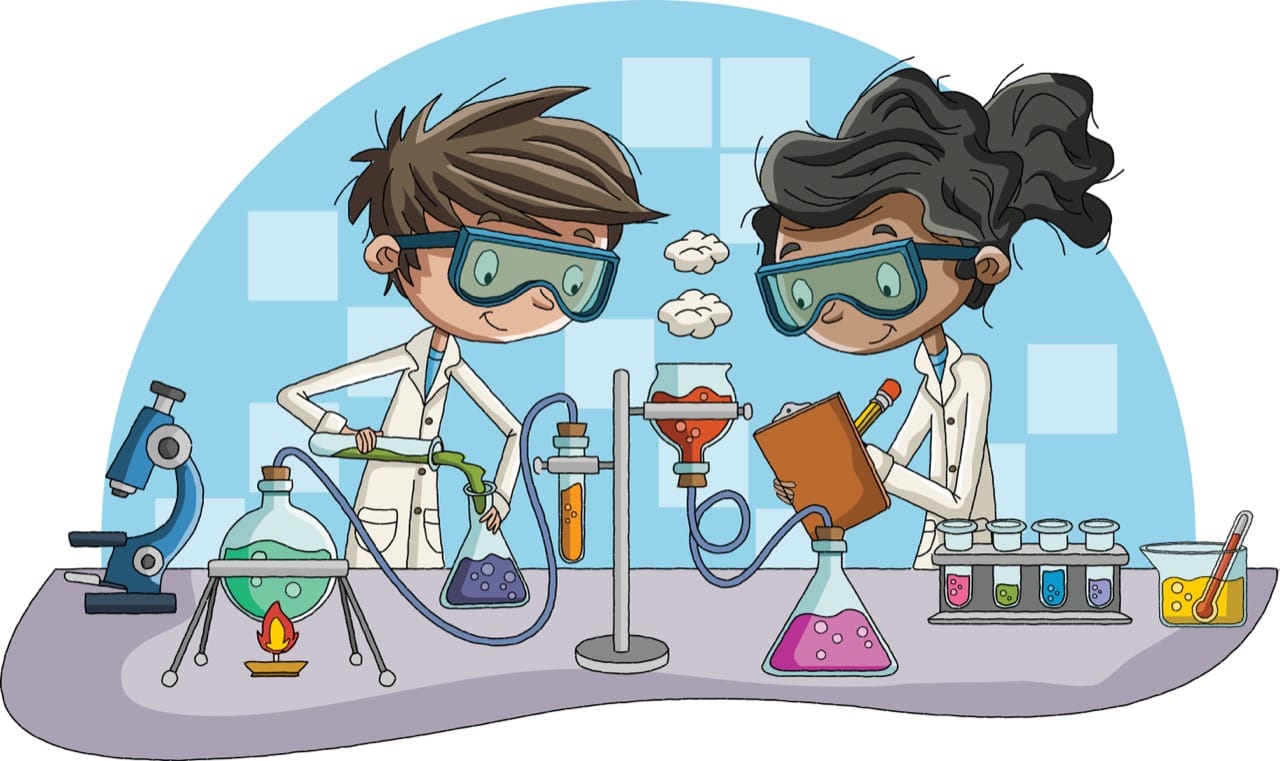
In a chemistry lab, it is easy to focus on the clinking glassware, colorful solutions, and roaring burners. Yet the real language of chemistry is much quieter. It lives in the symbols on the page: letters, arrows, lines, and brackets that together tell detailed stories about atoms and reactions. Learning to read these symbols is like learning to read music or a new alphabet. Once you see what they mean, the behavior of matter starts to make sense.
At the most basic level, chemical symbols stand for elements. A single capital letter, sometimes followed by a lowercase letter, represents each type of atom. H stands for hydrogen, O for oxygen, and Na for sodium. When these letters are grouped into formulas such as H2O or CO2, they show how many atoms of each element are present in a molecule. Subscripts, the small numbers written slightly below the line, are crucial. H2O is very different from H2O2, even though the letters look similar. The subscripts quietly change the identity and properties of the substance.
Chemical equations take this a step further by showing how substances change. Reactants appear on the left, products on the right, and an arrow points from what you start with to what you end up with. The arrow does not just mean equals. It means yields, indicating the direction of change. Sometimes chemists use a double arrow to show that a reaction is reversible, with reactants and products constantly interconverting. Coefficients in front of formulas balance the equation, making sure that the number of each kind of atom is the same on both sides. This reflects the conservation of mass, a core principle in chemistry.
Other arrows carry even more specific messages. In acid base chemistry, a curved arrow can show the flow of electrons from a base, which donates a pair of electrons, to an acid, which accepts them. The tip of the arrow points to where the electrons are going. These curved arrows allow chemists to trace who gains and who loses electrons in a reaction, almost like following the path of a ball being passed from one player to another.
In organic chemistry, lines and shapes stand for entire molecules. A simple zigzag line, called a skeletal structure, can represent a carbon chain with hydrogen atoms implied but not drawn. Double and triple lines between atoms represent double and triple bonds, which are stronger and shorter than single bonds. Lone pairs of electrons are sometimes shown as dots, while formal charges are written as plus or minus signs near atoms. Brackets can surround a group of atoms to show that the entire group carries a charge, forming an ion. These symbols help chemists understand why certain sites in a molecule are more reactive than others.
Even the arrangement of electrons around an atom has its own symbolic system. Orbital diagrams use boxes and arrows to show how electrons fill energy levels, while electron dot structures focus on valence electrons that participate in bonding. Together, these notations make it possible to predict bond formation, molecular shape, and reactivity.
To someone unfamiliar, this symbolic language can look like a secret code. With practice, however, each arrow, bracket, and squiggle becomes a clue. They guide you through the invisible world of electrons and energy, revealing why some reactions race ahead while others barely start. Becoming fluent in these glyphs of the great lab turns chemistry from a list of facts into a readable, logical story about how the molecular world works.